POSH Act Sensitisation Session
Delhi Public School, Vasant Kunj organised a sensitisation session on the Prevention of Sexual Harassment (POSH) Act for the school teaching and administrative staff on 14 September 2026 at the Multipurpose Hall.
The session was conducted by Adv. Akarsh Bhalla, who sensitised the teachers about the key provisions of the POSH Act, the importance of maintaining a safe and respectful workplace, and the responsibilities of employees and the Internal Complaints Committee. He also highlighted the significance of awareness, prevention, appropriate reporting mechanisms, confidentiality, and professional conduct.
The interactive session provided valuable insights and encouraged the staff to contribute towards fostering a safe, inclusive, dignified and harassment-free environment within the school. The session was informative and empowering, reinforcing the school’s commitment to ensuring safety, respect and zero tolerance towards sexual harassment.
.jpg)
.jpg)
.jpg)
.jpg)
POCSO Workshop - 2026
Workshop- Protection of Children against Sexual Offences (POCSO) Sensitization Programme.
Delhi Public School Vasant Kunj organised a workshop on Protection of Children against Sexual Offences (POCSO) sensitisation for cab drivers, bus drivers, bus helpers, security guards, house-keeping staff, Class-IV/V school employees and Admin Staff on the 8th of September 2026 in the Multi-Purpose Hall.
The Resource Person, Ms Divya Gehlot, Sub Inspector, Vasant Kunj Police Station, apprised the gathering about ‘good and bad touch’ and nuances of the POCSO Act. She emphasised upon the impact the lack of awareness of the unacceptable conduct can have on the students and the employees. She iterated that the act is gender neutral and affects everyone equally.
The informative session concluded with the felicitation of the guests.
.jpeg)
.jpeg)
.jpeg)
.jpeg)
.jpeg)
Role of Multiple Intelligence in a Classroom
The workshop on “Role of Multiple Intelligence in a Classroom” was conducted by the Junior School Counsellor, Ms Surpreet Oberoi, on 26th May, 2026 for the teachers of Classes I and II.
The session provided an understanding of the Theory of Multiple Intelligences proposed by Howard Gardener in 1983. It highlighted individual differences among children and emphasised the need for teachers to adopt different strategies in the classroom to achieve learning outcomes.
Ms. Surpreet Oberoi also shared various methods based on Multiple Intelligences such as Linguistic, Logical, Bodily - Kinesthetic etc. to achieve reading goals in classroom setting, especially while teaching sight words and syllabification technique.
The workshop encouraged teachers to think from the child’s perspective and emphasized that every child learns differently and their learning style should be incorporated to get the desired result.
It was an enriching and insightful session that enhanced teachers’ understanding of Multiple Intelligences.
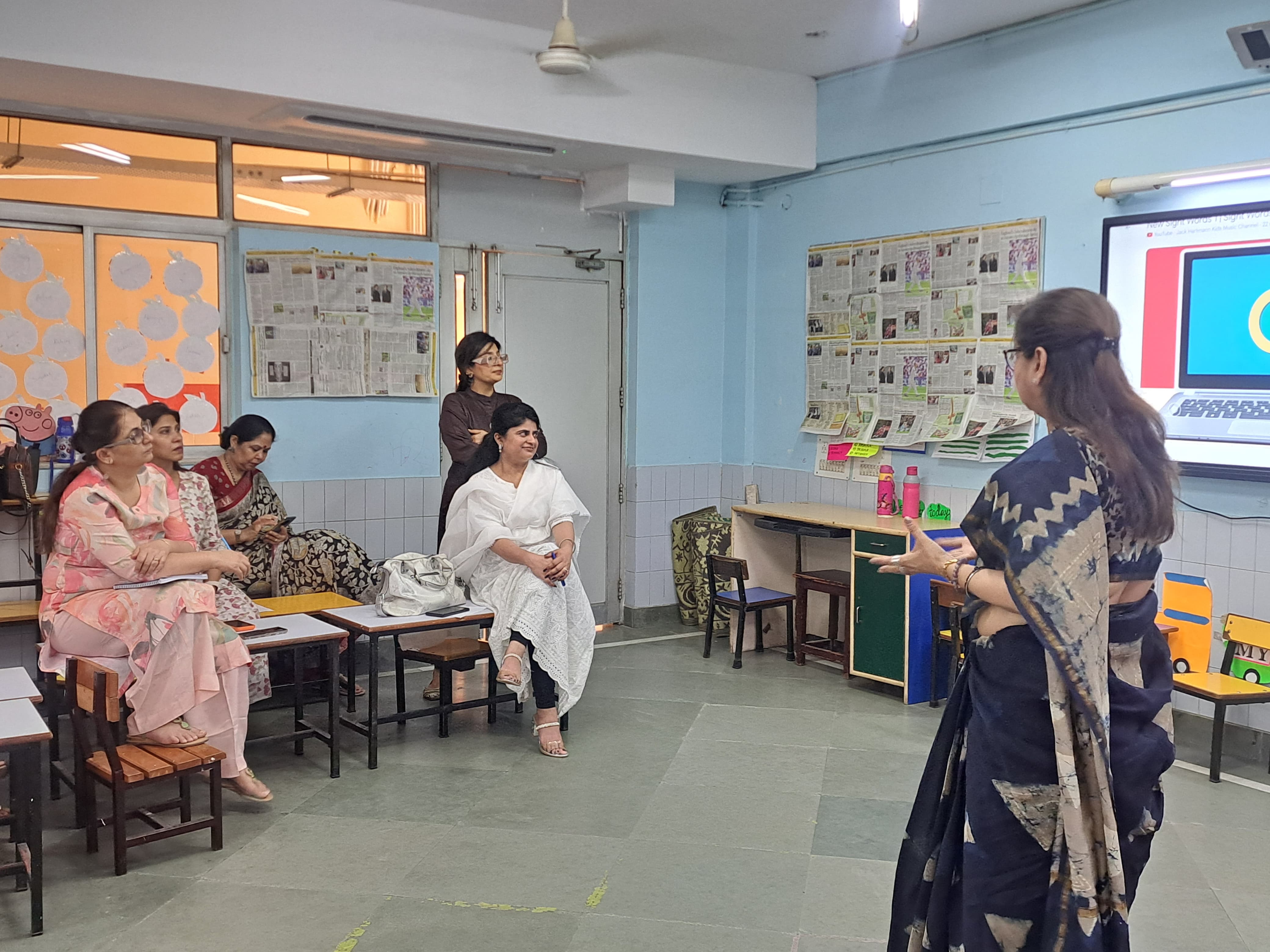
Handling Everyday Challenges in a Classroom Situation
The workshop on “Handling Everyday Challenges in a Classroom Situation” was conducted on 25th May, 2026 by the Junior School Counsellor, Ms. Surpreet Oberoi.
The session provided clarity about various disabilities and helped teachers understand how to identify, support and guide children.
Ms. Surpreet Oberoi shared valuable strategies specifically for Nursery and Prep children, focusing on early intervention, classroom adaptations, communication techniques, behaviour support, and social-emotional development. Different case studies were discussed in detail along with practical goals and strategies that teachers can implement in daily classroom routines.
The workshop was highly interactive, engaging, and meaningful. It encouraged teachers to think from the child’s perspective and emphasized that every child learns differently and deserves patience and acceptance.
Overall, it was a very fruitful and informative session that enhanced teachers’ understanding of special education and empowered them to support children more effectively.
DPSS-HRDC Residential
Training Programme in Early Childhood
Care & Education (ECCE)
A four-day residential training programme was organized by the Human Resource Development Centre (HRDC) of The Delhi Public School Society from 20th May to 23rd May, 2026 to align early childhood pedagogical practices with NEP 2020 and NCF-FS 2022. The programme brought together educators from 99 schools across India, focusing on foundational literacy, numeracy, responsive teaching, and holistic curriculum design. Ms. Neha Singhal from DPS, Vasant Kunj participated in the programme.
Key Session Summaries & Pedagogical Insights
1. National Curriculum Framework for the Foundational Stage (NCF- FS)
The resource person, Ms. Kinnari Pandya, Associate Professor, Azim Premji University, addressed the distinct developmental needs of children aged 3–8 years, emphasizing that play is the primary mode of learning. The session focused on creating emotionally secure, safe, and sensory-rich classroom environments where children learn at their own pace through exploration.
2. Responsive Teaching Through Differentiated Listening
The resource person, Ms. Garima Gupta, Faculty Member, Azim Premji University, introduced the concept of "100 Languages of Children" and highlighted the shift from passive hearing to diagnostic and differentiated listening. The session emphasized the Listening-to-Planning Cycle (Watch → Document → Interpret → Plan → Revisit) and encouraged the use of Universal Design for Learning (UDL) principles and tiered worksheets to prioritize equity over equality
3. Foundational Numeracy & Language Literacy
Dr. Asha Menon & Dr. Shobha Bharat from Smt. P.N. Doshi Women's College, Mumbai, advocated moving beyond rote memorization by using concrete materials such as beads, blocks to link mathematical concepts with daily life. They also emphasised the use of ELPS (Experience, Language, Pictures, Symbols) and MSOP (Matching, Sorting, Ordering, Pairing) frameworks to build a communication-rich ecosystem.
4. Nurturing Creativity & Curriculum Planning
The resource persons, Dr. Asha Menon & Dr. Shobha Bharat highlighted the importance of balancing divergent and convergent thinking through open-ended activities such as clay modeling and imaginative play. They also introduced the Content and Skill Webs for interdisciplinary planning and execution of the Panchadi Five-Step Learning Process: Adhiti (Introduction) → Bodh (Understanding) → Abhyas (Practice) → Prayog (Application) → Prasar (Expansion)
Each day concluded with evening yoga and therapeutic breathing sessions (Pranayama) conducted by Mr. Anand Mamgain and Mr. Madhusudan Nautiyal. These sessions focused on posture correction, stress reduction, and physical well-being to strengthen teacher resilience and overall wellness.
Overall, the programme was professionally enriching and inspired educators to create dedicated Maths Corners with concrete, hands-on learning objects and develop a print-rich classroom environment aligned with the Panchadi framework to foster functional independence and active literacy. It also focused on adopting flexible and responsive planning based on observational student portfolios instead of traditional assessment methods.
Good Behaviour Matters
An interactive session on, ‘Good Behaviour Matters’ was conducted on 30th April, 2026 by the Junior School Counsellor, Ms. Surpreet Oberoi, for the students of Class III.
The students were made aware of appropriate classroom behaviour through an engaging session using puppets, story telling and placards. Important topics such as bullying and good touch and bad touch were also discussed during the session.
The students thoroughly enjoyed the session, especially storytelling and puppets. The session concluded with a reinforcement of good manners with the help of placards, leaving the students more aware and responsible.
Kaushal Bodh Programme
CBSE organised the Capacity Building Programme - Kaushal Bodh on 17th January 2026 at ITL Public School, Dwarka. The programme aimed at enhancing teachers’ understanding and effective implementaion of skill-based education as envisioned in the National Education Policy. It was attended by the School Headmistress, Ms Mamta Narula, Ms. Sangeeta Vachher, Rep Class VI, Ms Tanika Vasudeva, Rep Class VII and Ms. Nirmala Sharma, Rep Class VIII. The resource persons, Dr Shyda Rana, Independent Consultant, Army Public School and Dr Sudha Acharya, Principal, ITL Public School, shared valuable insights into the objectives, structure, and classroom integration of Kaushal Bodh.
They laid emphasis on developing life skills, experiential learning, competency-based education, and pracƟcal classroom strategies to engage students effectively. The programme was interactive and included discussions, real-life examples, and collaborative activities, which helped the participants gain clarity on pedagogical approaches and assessment techniques related to skill education.
Click here for details.